



Mapping triple-negative breast cancer to better understand chemotherapy response
November 04, 2026
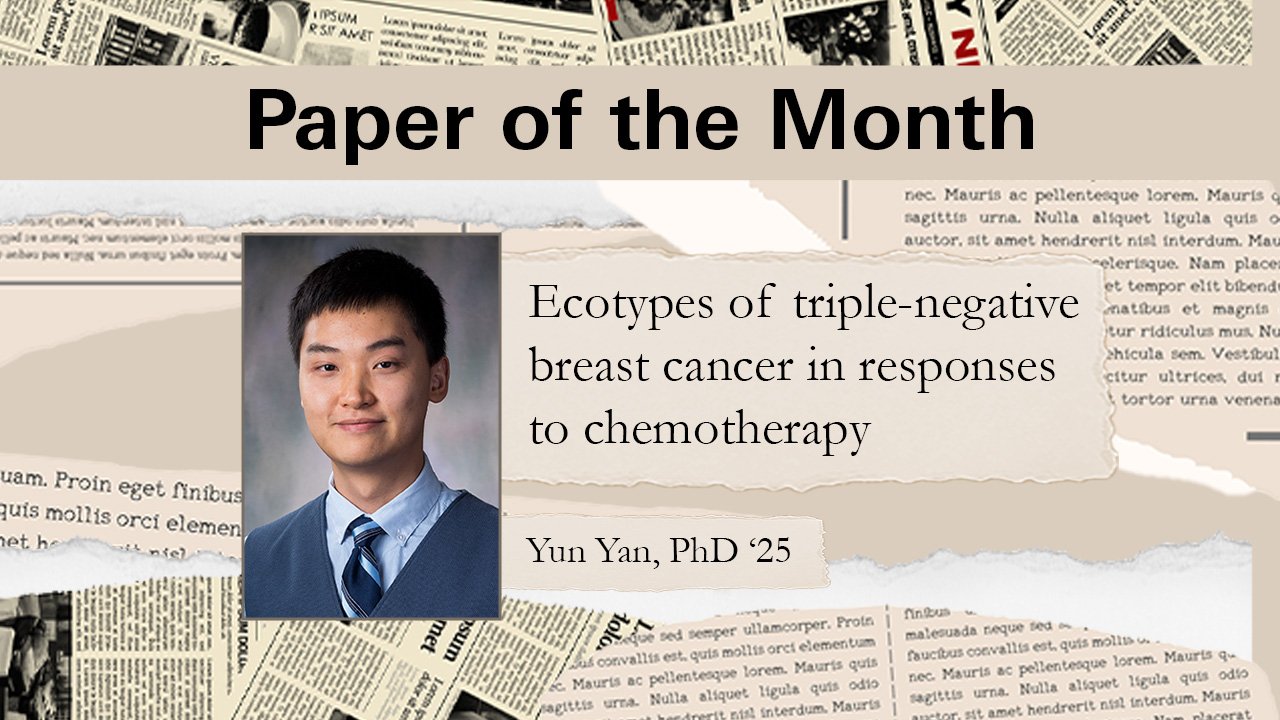
November Paper of the Month: Ecotypes of triple-negative breast cancer in responses to chemotherapy
Triple-negative breast cancer (TNBC) is an aggressive form of breast cancer, and chemotherapy given before surgery remains the standard first treatment for early-stage cases. While options have improved for advanced cases, doctors still struggle to predict which patients will respond well to standard chemotherapy and those who would benefit more from alternative treatments.
To help solve this problem, Yun Yan, PhD, an alumnus of the Biomedical Data and AI-Driven Decision Sciences Program, (previously known as the Quantitative Sciences Program), and his mentor, Nicholas Navin, PhD, professor at and Chair of the UT MD Anderson's Department of Systems Biology, Division of Discovery Sciences, looked closer at how individual cancer cells behave and interact. Using cutting-edge single-cell and spatial technology, they created detailed maps showing what individual cells were doing as well as where they were located inside tumor tissues.
Published in Nature, their landmark study analyzed tumor samples from 108 patients before they started treatment, revealing how the diversity and physical layout of cancer cells influence how well a patient responds to chemotherapy.
Now a postdoctoral researcher in the Navin Lab, Yun reflects on how his graduate school journey shaped his approach to research.
“My PhD work at MD Anderson uniquely introduced me to the ‘warmth’ of science: seeing how discoveries could ultimately benefit patients.”
Today, he carries this sense of purpose into his postdoctoral research, pursuing scientific curiosity while seeking to identify clinical challenges where his work can make a difference.
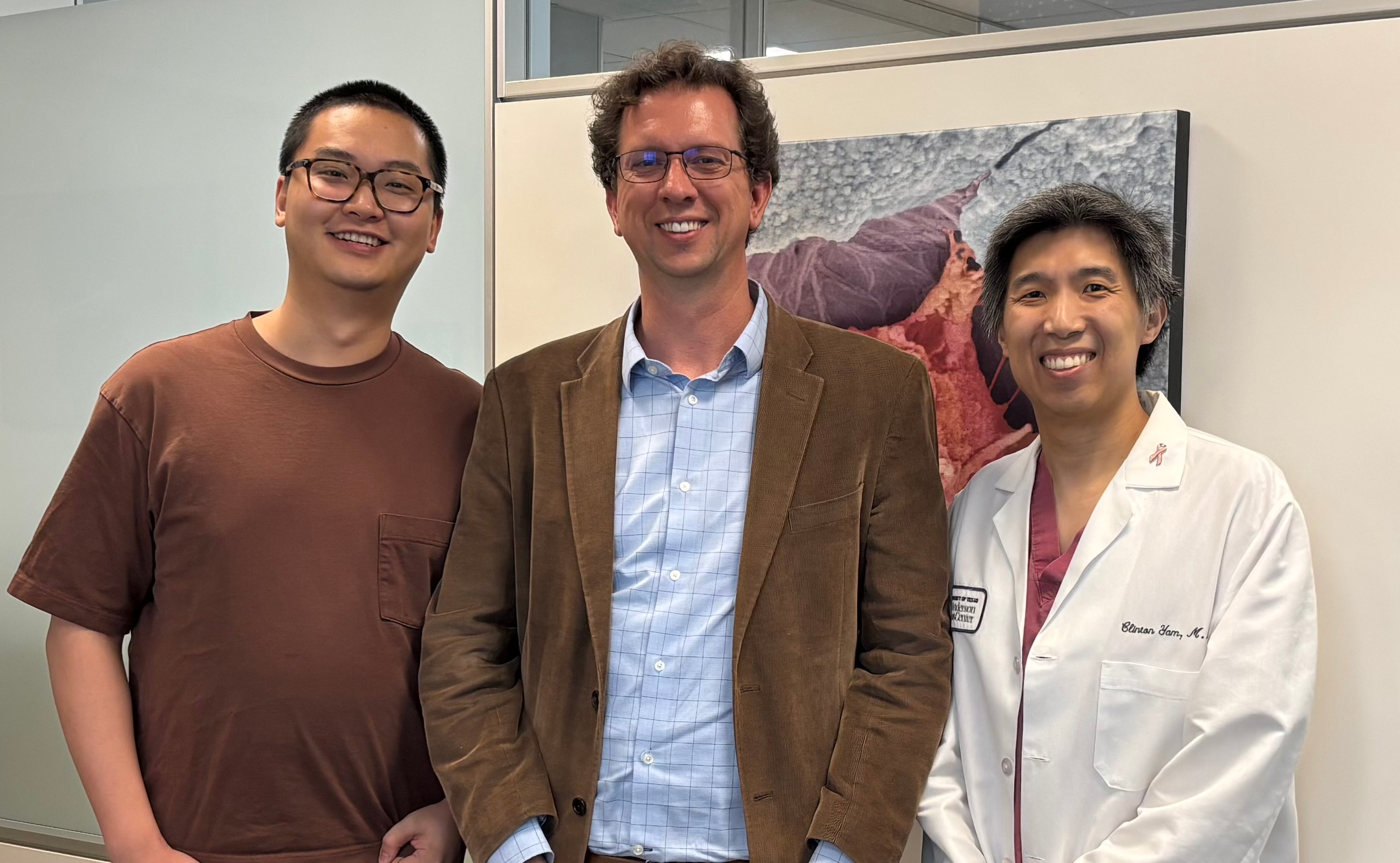
Yan (left) with his mentor Nicholas Navin, PhD, (middle) and their clinical collaborator Dr. Clinton Yam, MD, MS (right).
Different cell types, different treatment responses
Traditional methods for studying triple-negative breast cancer usually analyze tumor samples all at once. Because tumors contain a mix of cancer cells and healthy supporting cells, this "bulk" approach makes it hard to see what the cancer cells are doing on their own.
To get a clearer picture, Yan and the research team examined nearly 50,000 individual cancer cells across 97 patient samples. This allowed them to isolate the cancer cells' unique activity patterns, revealing four distinct cancer types (or "archetypes"):
- Luminal-secretory-like
- Basal-like
- Interferon-responsive (immune-activating)
- Androgen receptor-enriched
They confirmed these same four patterns appeared across three additional large patient datasets, showing that these cancer types are consistent features of TNBC. Furthermore, most patients had tumors dominated by a single pattern.
Critically, these four archetypes directly predicted how patients responded to chemotherapy:
- Patients with basal-like tumors were more likely to have remaining cancer after treatment and shorter overall survival.
- Patients with interferon-responsive tumors were much more likely to have their cancer completely wiped out by chemotherapy and lived longer.
These findings help explain why some TNBC tumors resist chemotherapy while others disappear entirely, offering a new roadmap to help doctors tailor treatments to individual patients before therapy even begins.
Inside the tumor: diverse cellular "toolkits"
Even within a single tumor, cancer cells do not all behave the same way. To understand this internal diversity, the team identified 13 common activity patterns (called "metaprograms") that cancer cells use to function. These programs act like internal toolkits that fall into five main roles:
- Growth and division (cell multiplication)
- Protein production (cell maintenance)
- Stress response (handling stress)
- Immune signaling (communicating with immune cells)
- Cell identity (defining tissue structure)
They found that these toolkits directly influence chemotherapy outcomes:
- Tumors that were eliminated by chemotherapy had much higher levels of cells that were rapidly dividing, stress responsive, and immune signaling.
- In some cases, chemotherapy success was not due to having more cells with a specific toolkit, but rather individual cells turning up the activity level of that toolkit.
The takeaway: predicting chemotherapy success is not just about counting cancer cells, it is about knowing which internal programs those cells are running and how hard they are working.
The tumor neighborhood and treatment response
Treatment success does not depend on cancer cells alone but also relies on the surrounding "neighborhood" of immune and supporting tissue cells, known as the tumor microenvironment. By analyzing over 350,000 immune cells and 23,000 supporting structural cells, the research team uncovered striking differences between tumors that disappeared after chemotherapy and those that resisted it.
Tumors that were eliminated by chemotherapy were packed with immune-activating, lipid-processing macrophages and immune-supportive blood vessel cells. In contrast, resistant tumors relied on tissue-remodeling macrophages that shield cancer from damage, as well as specialized vessel cells that nourish tumor growth. Ultimately, chemotherapy response is a full team effort: how well treatment works depends on both the cancer's identity and the surrounding cells fighting or protecting it.
Cancer neighborhoods and predicting treatment response
To see how cancer and surrounding cells form organized communities, the team mapped these cellular networks into eight distinct "ecotypes" and ten spatial regions ("niches") within the tumor tissue. They discovered that these cellular neighborhoods directly influence treatment outcomes: immune-rich, active neighborhoods were common in tumors completely wiped out by chemotherapy, while tissue-remodeling, vessel-building neighborhoods dominated resistant tumors.
Translating these complex discoveries into a practical clinical tool, they developed a machine-learning model using a 13-gene signature that can be tested on standard tumor samples. Validated across two independent patient groups, this simple gene test accurately predicted both chemotherapy resistance and overall patient survival, paving the way for accessible diagnostic tests to guide treatment decisions.
From cellular maps to clinical potential
Yan and the research team’s work deepens our current understanding of transcriptional programs of cancer cells and the diverse tumor microenvironments that shape TNBC biology and chemotherapy response. Reflecting on the broader significance of this study, Yan emphasized its potential to advance how researchers understand and study cancer:
“Our work provides a broadly applicable data science framework for understanding tumors as integrated ecosystems. Using single-cell and spatial omics, we resolved differences between patients and heterogeneity within individual tumors.”
He also highlighted the translational impact of these findings, which could help “predict treatment response, with the potential to complement clinical decision-making and benefit patients.”
UT MD Anderson UTHealth Houston Graduate School of Biomedical Science’s Paper of the Month is a collaborative effort led by PhD candidate Mirrah Bashir; Shelli Manning, communications manager; and Lauren Nguyen, communications assistant. Oversight is provided by Francesca Cole, PhD, associate dean for Academic Affairs at UT MD Anderson UTHealth Houston Graduate School. Students are trained to summarize fellow student-authored scientific articles about their biomedical science research and the innovative methods and discoveries they are uncovering. The Paper of the Month editorial team includes students Chae Yun (Kate) Cho (author of November's summary), Sheighlah McManus, Sarah Schneider, Trisha Wathan, Anna Debruine, Trithi Sunder, and Ryan Sloan.