


Building a community in science: Zeph Kaffey, PhD, puts medical physics to work for patients
October 26, 2026
Before Zeph Kaffey, PhD ’26, set her sights on medical physics, she was studying the universe.
As an undergraduate physics major, Kaffey had the opportunity to conduct astrophysics research, including studying quasars. She enjoyed the work but began thinking about how she wanted to use physics over the course of her career. She realized she wanted a more direct connection to people and patient care.
Medical physics offered that connection.
“I wanted to use the physics knowledge that I had in a way that would help patients and improve their quality of life.”
That goal eventually brought Kaffey to The University of Texas MD Anderson Cancer Center UTHealth Houston Graduate School of Biomedical Sciences, where she earned her PhD in Medical Physics in May.
Finding mentorship and belonging
For Kaffey, some of the most important parts of graduate training came from the people around her.
She describes her advisor, Clifton David Fuller, MD, PhD, as both a mentor and a sponsor — two roles she sees as distinct but equally valuable.
“Sponsors are people who will put your name in rooms that you aren’t in, and mentors are people who will show you the ropes.”
Fuller, she said, brought the two together, offering support while challenging students to see more in themselves.
“He will push us and see the champion in us before we see it in ourselves.”
Kaffey points to a philosophy Fuller often shares with his students: “The lab works for you. You don’t work for the lab.”
For Kaffey, that philosophy reflects the kind of mentorship that made her Graduate School experience so meaningful — support designed around helping students grow, find their strengths, and build toward their own goals.
Growing as a student and leader
Kaffey also found support among fellow students.
While her master’s training took place during the COVID-19 pandemic, when remote learning limited opportunities to study alongside classmates, she found a different experience after enrolling in the PhD program at the Graduate School.
She developed relationships with peer mentors who had already progressed through the Medical Physics Program, as well as students in and around her own cohort. Studying together, working through problems, and having people she could approach with questions became an important part of her training.
“We definitely teach each other.”
Kaffey’s development extended beyond Medical Physics. She was one of four Graduate School students selected for UTHealth Houston | Leads, a one-year fellowship program designed to develop future leaders in healthcare.
She also represented her peers on the Graduate Education Committee and Curriculum Committee, raising student concerns and bringing their perspectives to decisions affecting their Graduate School experience, from parking and housing information for incoming students to the review of new and existing courses.
Putting her training into practice
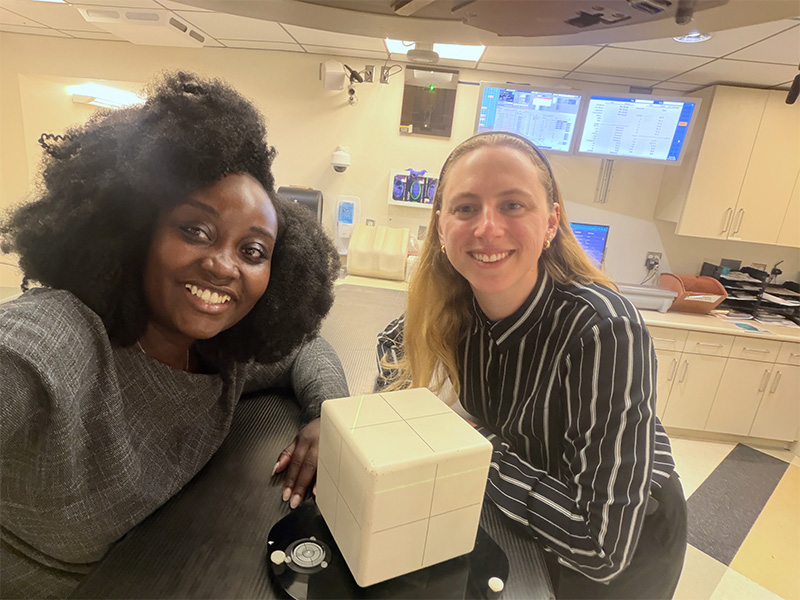 Just two months after graduating, Kaffey moved to San Diego and began a two-year clinical residency in the Medical Physics Residency Program at the University of California San Diego.
She is now gaining hands-on experience in radiation oncology physics, including treatment planning, machine quality assurance, and patient safety, as she works toward board certification.
The transition brings Kaffey closer to the reason she chose medical physics in the first place: applying physics in ways that directly affect patients.
Her longer-term goal is to become an academic clinical medical physicist, allowing her to care for patients while continuing research and eventually mentoring the next generation of physicists. (Kaffey, right, working with co-resident at University of California San Diego.)
At UC San Diego, she is building on that foundation, continuing to grow as a scientist while taking on an increasingly direct role in patient care.