





April’s Paper of the Month highlights the beauty of following the science
April 22, 2026


Paper of the Month: AXL promotes inflammatory breast cancer progression by regulating immunosuppressive macrophage polarization
Joining a new lab involves quickly adapting to new methods, understanding different research areas, and contributing meaningfully. This requires flexibility, openness, and motivation to learn to become a valuable team member. This month’s featured research, authored by Lan T. H. Phi, a recent graduate from the Cancer Biology program, and published in Breast Cancer Research in May 2025, reflects this exact experience.
The project was initially built on prior work focusing on AXL, a tyrosine kinase receptor, and on the use of various inhibitors supplied by pharmaceutical partners. The aim was straightforward: to validate and further develop earlier results. Yet as the experimentation continued, the outcomes didn’t align with previous data. Unfortunately, the inhibitor didn’t demonstrate a significant benefit over standard treatments, leading to a tough but crucial realization: an adjustment to the original approach was necessary.
Although frightening, this moment became a turning point. Instead of trying to make the project fit previous conclusions, Phi embraced the uncertainty. The focus changed from "How do I replicate this?" to "What is the biology actually telling me?” What followed was a deeper exploration into the tumor microenvironment — specifically, the role of macrophages in inflammatory breast cancer.
Uncovering a hidden driver in inflammatory breast cancer
Inflammatory breast cancer (IBC), although rare, is one of the most aggressive and understudied forms of breast cancer, due to its rapid progression and poor clinical outcome. AXL is a large focal point for Phi’s lab and the center of this research article. It is known to help cancer cells survive, invade, and resist therapy; however, this study highlights a new role of AXL in which it influences not only cancer cells but also immune cells within the tumor microenvironment (TME).
One of their most significant findings was that AXL reprograms immune cells (i.e., tumor-associated macrophages [TAMs] and regulatory T cells [Tregs]) in the TME, with AXL’s effect on macrophages highlighted. There are two subsets of macrophages: M1 and M2. At one end of the spectrum, M1 macrophages promote inflammation, inducing an immune response and are considered anti-tumoral. At the other end, M2 macrophages dampen the host immune response by releasing anti-inflammatory cytokines and growth factors that reduce cytotoxic T cell activity, thereby enhancing cancer cell survival, and promoting angiogenesis. Phi et al demonstrated that AXL signaling skewed monocyte differentiation toward M2-like macrophages. For instance, samples with higher AXL signaling showed significant increases in CD206+ and CD163+ macrophages, which are canonical markers of M2 polarization.
Naturally, the next progressive question is how exactly AXL signaling is related to monocyte differentiation into TAMs. The authors identified that the STAT6 signaling pathway was a key downstream mediator of AXL’s effects. STAT6, a transcription factor, is activated by cytokines such as IL-4 and IL-13, which are present in the TME. This signaling cascade has been previously described as essential for M2 polarization. In Phi et al.'s research, they observed that AXL activation led to increased phosphorylation and, in this case, to STAT6 activation. Physiologically, this supports an immunosuppressive environment. Subsequent inhibition of AXL, either pharmacologically using TP-0903 or through genetic knockdown, decreased STAT6 activation, and the macrophage population showed reduced M2-like phenotypes.
Taking a step away from immune cells and looking at the complete neighborhood, or TME, AXL was shown to reshape its secretory profile. This study found increased expression of the chemokines CCL20 and CCL26 and the growth factor epiregulin (EREG). Historically, these molecules have been linked to a plethora of tumor-associated behaviors, such as recruiting immunosuppressive cells, enhancing tumor proliferation, and aiding the migration and invasion of cancer cells. Essentially, this shows that AXL signaling not only suppresses host immunity but also actively creates an environment that nurtures tumor growth.
Phi mentioned that although there was initial difficulty in finding the right model, they observed these results both in vitro (using the human IBC cell lines SUM149 and BCX010) and in vivo (using the TNBC 4T1.2 and E0771 immunocompetent syngeneic mouse models). Most importantly, high AXL expression in patient-derived samples correlated with increased infiltration of immunosuppressive immune cells, including M2 macrophages and Tregs. This strengthens the case for targeting AXL signaling and highlights the clinical relevance of this molecule. Collectively, Phi et al.’s work sheds new light not only on AXL but also on the idea of shifting perspective and looking beyond the tumor cell. The TME is a vast network of cell types that can be used for good or bad, depending on the perspective.
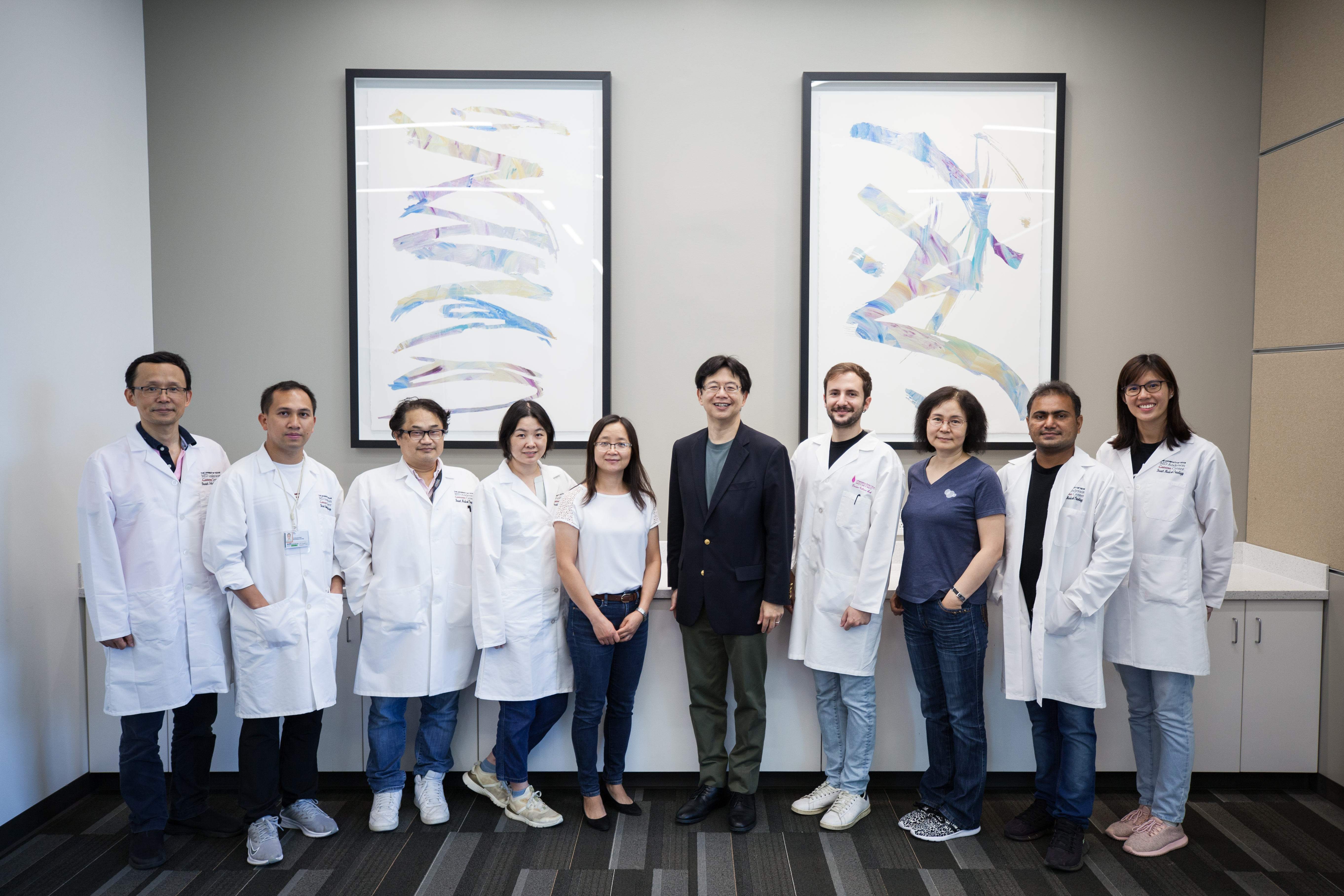
Phi with advisor Naoto T. Ueno, MD, PhD, and labmates in 2022.
The power of pivoting
What makes this story most impactful is not only the scientific findings but also the story behind them. Phi’s biggest adjustment was stepping into a new workspace and reconciling with someone else’s previous work. In the end, she had to trust herself and the data that emerged. While this can be daunting, it is transformative: leading to self-improvement as a scientist and an increase in one’s confidence, as was the case for Phi.
Reflecting on her experience, Phi emphasized a vital lesson and expressed her view that science is not solely about confirming past results but about seeking the truth wherever it may lead. Additionally, the act of turning experimental findings into a narrative — “writing the manuscript like a story” — not only influenced her paper but also helped her grow as a scientist. Most importantly, she wanted to underscore a broader message that goes beyond this study.
“Just because something doesn’t do what you planned it to do doesn’t mean it’s useless.” – Thomas A. Edison
Paper of the Month (POM) is a collaborative effort led by Microbiology and Infectious Diseases PhD candidate Jana Gomez, Communications Manager Shelli Manning, and Communications Assistant Lauren Nguyen, and overseen by Associate Dean for Academic Affairs Francesca Cole, PhD, who work with students to summarize fellow student-authored scientific articles about their biomedical science research and the innovative methods and discoveries they are uncovering. The POM editorial team includes students Shraddha Subramanian, Mirrah Bashir, Amanda Warner, Chae Yun Cho, Altai Enkhbayar, Zarmeen Khan, Archit Gupta, and Sheighlah McManus (author of April's POM summary).