




February’s Paper of the Month introduces a novel approach to train radiation oncology residents
February 27, 2026


Paper of the Month: Intentional creation of suboptimal, realistic dose distributions
The goal of radiation oncology residencies is to train the next generation of radiation oncologists. Yet, despite extensive training, residents report feeling substantially underconfident and underprepared in reviewing radiation treatment plans. A major contributor is limited exposure to diverse disease sites and treatment plans. Recognizing this gap, Medical Physics PhD student Skylar Gay, and his team members in the lab of Laurence E. Court, PhD, set out to address the issue in their latest paper, Intentional creation of suboptimal, realistic dose distributions, published in the Journal of Applied Clinical Medical Physics in May, 2025.
Expanding training through simulation
As Gay describes it, his solution functions as a “flight simulator” for radiation oncology residents. Pilots must gain experience flying in harsh and dangerous conditions, but it is neither safe nor practical to fly through storms. Similarly, many training environments offer limited case diversity: 25% of academic centers and 55% of community centers in the United States treat fewer than four head and neck cancer cases annually. With such limited exposure, how can the next generation of radiation oncologists build expertise? To address this challenge, Gay developed a computer algorithm that automatically generates realistic, suboptimal dose distributions. By expanding training datasets from a handful of cases to thousands of treatment plans, residents can practice identifying suboptimal treatment plans, proposing improvements, and learning from a wide range of clinically relevant examples.
Gay’s algorithm models suboptimal plans by introducing controlled perturbations to predicted volume-modulated arc therapy (VMAT) plans. First, high-quality dose distributions are generated using deep learning methods. These plans are then systematically degraded in one of three ways: increasing the dose to organs-at-risk, decreasing the dose around targets, or introducing high-dose regions within the target. However, modifying dose distributions is not trivial. Changes in one region must be accompanied by physically and geometrically consistent adjustments in neighboring regions. To account for this, Gay developed a geometrically aware convolution method that enables coordinated updates to neighboring regions and restrictions to localized regions. This approach provides precise control over both the location and magnitude of dose changes. In the paper, he demonstrated that the method successfully reduces organ-at-risk sparing, decreases coverage of high-risk targets, and introduces hotspots in high-risk targets, effectively simulating errors observed in real treatment planning.
One of Gay’s biggest challenges was modeling the anatomy of human error. “If my dog steps on my keyboard, he will create a suboptimal treatment plan,” he quipped. “But that treatment plan will not reflect the kinds of mistakes trained oncologists actually make.” To achieve this, he worked closely with collaborators to build a mental model of how treatment plans are created and where realistic suboptimalities can arise. Gay credits the project’s success to the diverse expertise of his team. It was the insight and experience provided by physicians, physicists, and dosimetrists that eventually made the model both useful and applicable.
AI-enhanced training as a global solution
Ultimately, Gay’s work is motivated by the goal of bringing high-quality radiotherapy worldwide.
“In the U.S., we have many treatment centers and substantial resources. Much of the world, however, remains under-resourced."
In many developing nations, patient demand far exceeds available infrastructure, and new facilities cannot be built overnight. Training the existing workforce more effectively is therefore a critical lever for improving patient care.
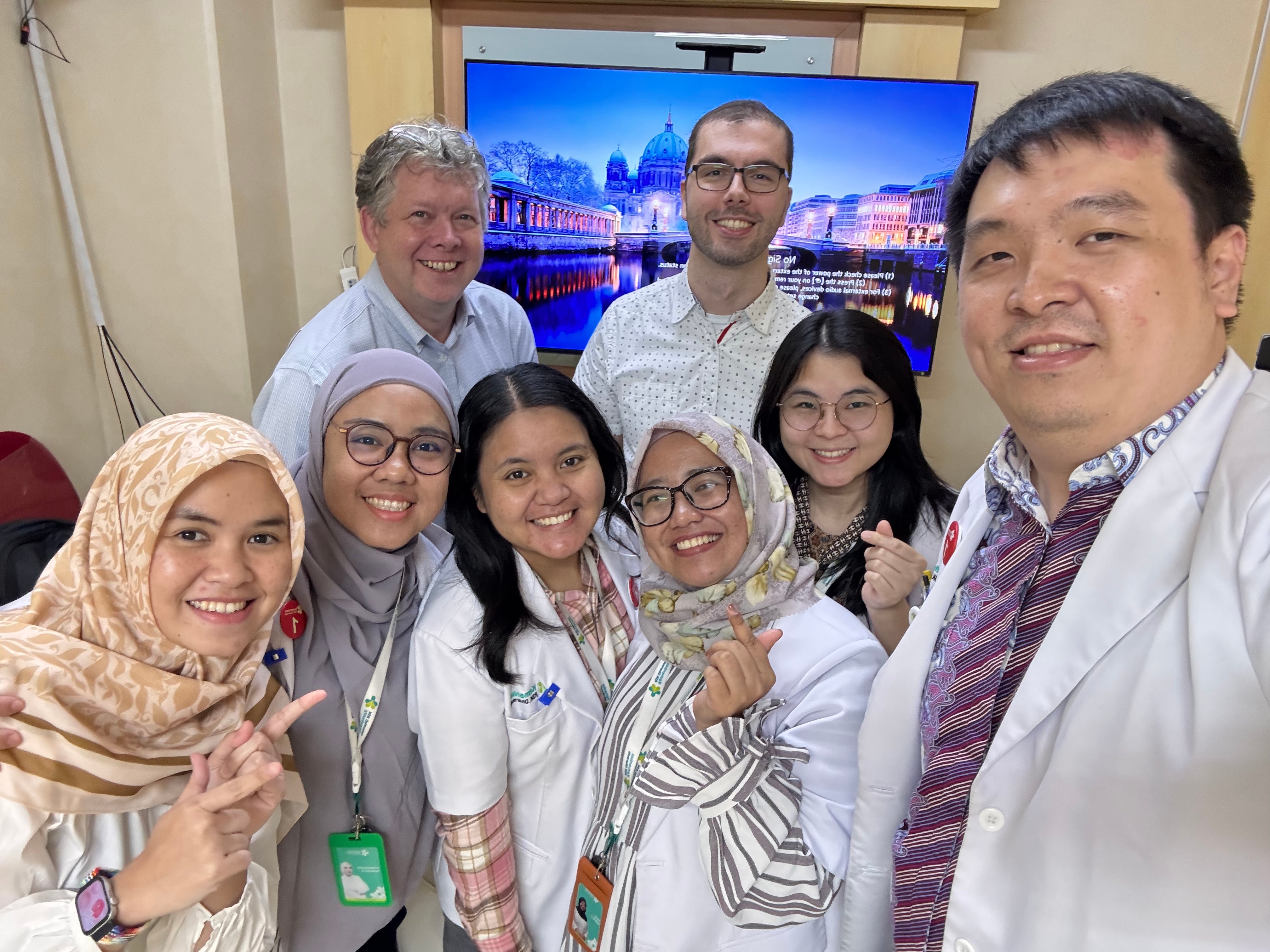
To extend this work, Gay has already begun his next project. The current system has two limitations: the underlying physics is not fully captured, and it does not allow trainees to improve plans and obtain feedback. To address these gaps, he is developing an artificial intelligence system with a more robust physics foundation that allows trainees to interact with the model and receive guidance on improving treatment plans. This platform has already been developed and is currently being tested at one hospital in the United States, two in Indonesia, and two in South Africa, where Gay has helped deploy the software in clinical training environments.
Paper of the Month (POM) is a collaborative effort led by Microbiology and Infectious Diseases PhD candidate Jana Gomez, Communications Manager Shelli Manning, and Communications Assistant Lauren Nguyen, and overseen by Associate Dean for Academic Affairs Francesca Cole, PhD, who work with students to summarize fellow student-authored scientific articles about their biomedical science research and the innovative methods and discoveries they are uncovering. The POM editorial team includes students Shraddha Subramanian, Mirrah Bashir, Amanda Warner, Chae Yun Cho, Altai Enkhbayar, Zarmeen Khan, Archit Gupta (author of February's POM summary), and Sheighlah McManus.