




June’s Paper of the Month: Unraveling the function of MutSgamma during meiotic chromosomal segregation
June 23, 2026

Paper of the Month: MutSgamma promotes meiotic recombination and homolog pairing in mouse spermatocytes
Chromosomes, which consist of condensed DNA, make up our genetic information that controls traits, like eye color, or even disease risk. During cell division, a highly orchestrated series of steps is required which include duplication of the DNA and separation of the chromosomes into two new daughter cells. It is especially important that chromosomal segregation is properly regulated during meiosis where one cell, such as a primary spermatocyte, generates four sperm each with half the chromosome complement of the progenitor. One wrong step in chromosome segregation can have detrimental consequences, namely infertility, miscarriages, and developmental disorders.
Unfortunately, many of the mechanisms underlying meiotic chromosome segregation remain unknown. Part of this is due to differences in meiosis across organisms which makes meiosis difficult to study. The steps of chromosomal segregation and the functions of the proteins involved in this process need to be understood to develop therapies that can alleviate or prevent infertility.
Recent graduate from the Genetics and Epigenetics program at UT MD Anderson UTHealth Houston Graduate School of Biomedical Sciences (GSBS), Melissa Frasca, PhD, published a paper on this topic in Genetics. Her research dives deep into cell biology mechanisms using elegant microscopy and genetic experiments with spermatocytes.
Brief overview of chromosomal segregation
To study chromosomal segregation, a primary spermatocyte is imaged under a microscope at prophase I of the cell cycle where the 20 pairs of chromosomes have already been duplicated. The matching chromosomes that came from the female and male parent model organism need to first find each other in a dense nucleus that is full of DNA with highly repetitive regions. This process is called pairing.
Next, the paired duplicated chromosomes undergo synapsis where they become ‘glued together’ by a multiprotein protein complex called the synaptonemal complex that spans the entire length of the chromosomes. The final step is for the non-sister chromatids, that is the chromatid from each parent, to swap entire arms of DNA by homologous recombination, which ensures accurate chromosome segregation and genomic diversity.
Role of MutSgamma in chromosomal segregation
When Frasca began her graduate journey in the lab of Francesca Cole, PhD, she was most excited about studying a protein called MutSgamma. This protein has been shown to regulate pairing, synapsis, and homologous recombination — all of which are required for chromosome segregation in many organisms, including humans. In some preclinical models, MutSgamma promotes synapsis and recombination; however, it is unclear if MutSgamma also promotes chromosome pairing.
Frasca set out to determine the detailed role of MutSgamma during chromosomal segregation. Some functions of MutSgamma depend on its ATPase domain. Therefore, two different mutant MutSgamma spermatocyte preclinical models were analyzed. The first model had a deletion of a portion of MutSgamma that restricted the full active complex to form. The other model included a mutation in the ATPase domain of a subunit of MutSgamma.
After assessment by immunofluorescence and flow cytometry, mutant spermatocytes showed limited capacity to form the synaptonemal complex and tended to stall in the middle of prophase I as compared to wildtype cells. This data indicates an impairment in synapsis.
Specific regions of chromosomes are termed hot spots since since they are sites of frequent meiotic double stranded breaks that induce homologous recombination. A nested PCR technique identified that mutant spermatocytes had severely impaired recombination which indicates the double stranded breaks were likely not resolved and genetic exchange was not completed.
Lastly, fluorescence in situ hybridization (FISH) was used to determine pairing efficiency in MutSgamma mutants compared to wild-type spermatocytes or those entirely lacking in homologous recombination. Mutant spermatocytes had less pairing in both long and short chromosome pairs, but shorter chromosomes were more affected. Spermatocytes bearing mutated MutSgamma had less difficulty in compacting chromosomes after pairing in mid-prophase I stages as compared to spermatocytes entirely devoid of recombination. This lack of chromosome compaction indicates impairments in chromosomal pairing as well.
“My favorite part [of this work] was learning to perfect the FISH staining and how to best measure pairing in those images.”
Frasca optimized this experiment so now other lab members can use the technique for their own projects.
Overall, her work indicates that MutSgamma plays a role at an earlier stage in mammalian meiotic recombination than expected, likely due to stabilization of a recombination structural intermediate. This work not only provides insight into the mechanisms of mammalian meiosis but is also important in the context of addressing treatments for infertility.
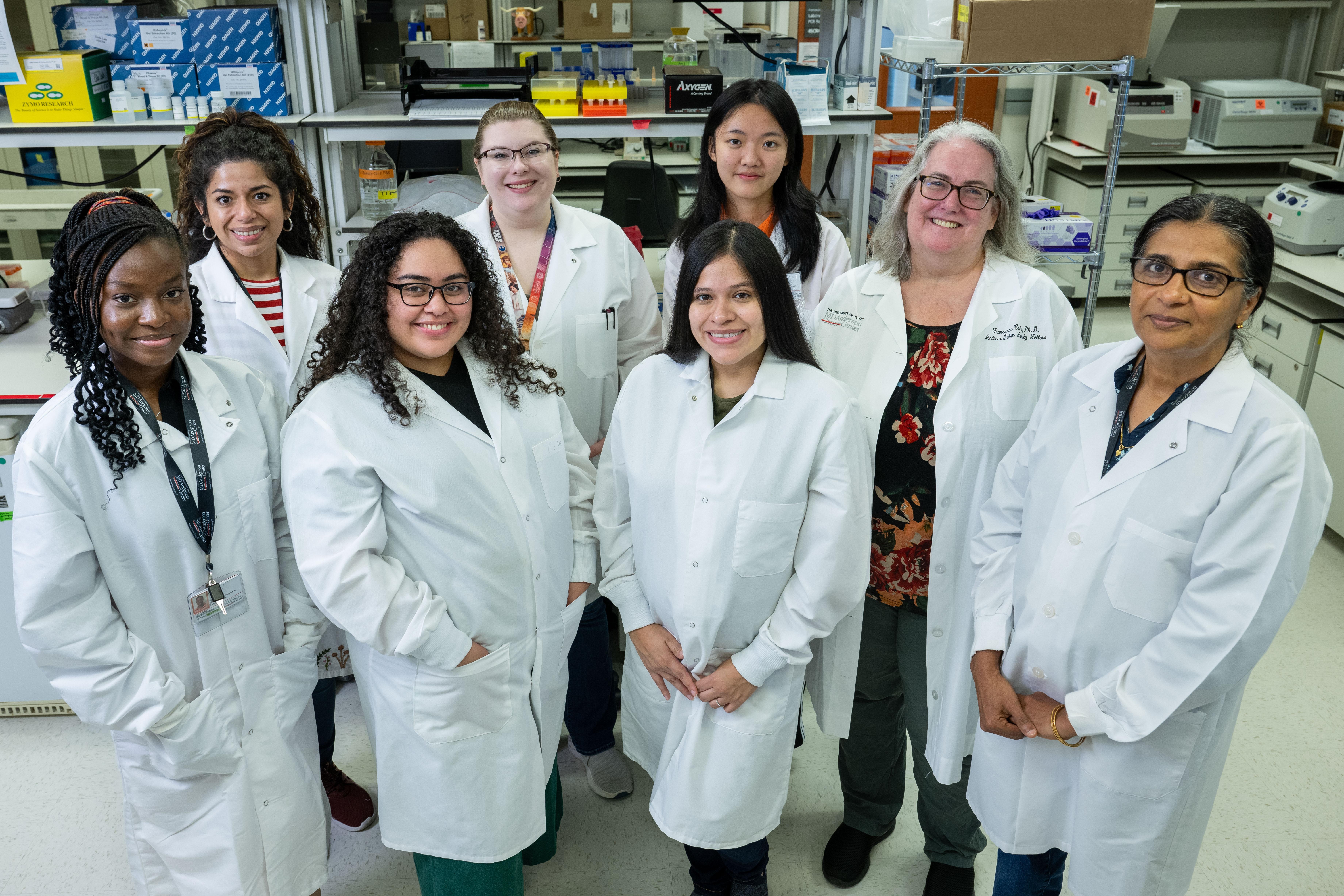
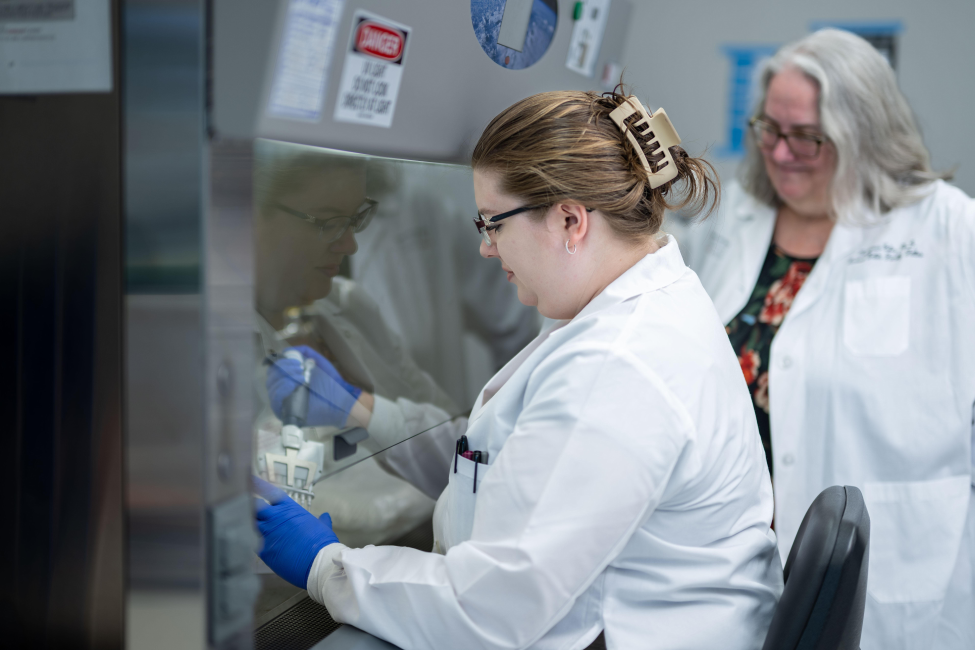
Frasca alongside her lab members and mentor, Francesca Cole, PhD.
Stop and zoom out to see the big picture
As a recent graduate, Frasca shares advice to encourage current students, “I definitely learned that it’s best to think about the big picture of my story every once and a while, especially when my experiments weren't working or things were extra tiring or taxing. And your story will change as you get more and more data and that's okay! It's not something to be afraid of or worried about. That's what science is about — learning from failures and continuing to try again and again.”
Frasca was a very accomplished student during her time at the Graduate School as she received over 15 awards, including the Linda M. Wells Outreach Award for her work in the GSBS Community Outreach student association, where she shared her passion for science with K-12 students. She has a bright future in research ahead!
Paper of the Month (POM) is a collaborative effort led by Molecular and Translational Biology PhD candidate Mirrah Bashir, Communications Manager Shelli Manning, and Communications Assistant Lauren Nguyen, and overseen by Associate Dean for Academic Affairs Francesca Cole, PhD, who work with students to summarize fellow student-authored scientific articles about their biomedical science research and the innovative methods and discoveries they are uncovering. The POM editorial team includes students Amanda Warner (author of June's POM summary), Chae Yun Cho, Altai Enkhbayar, Sheighlah McManus, Sarah Schneider, Trisha Wathan, Anna Debruine, and Trithi Sunder.