


From training to patient advocacy: Jessica Scarlett to serve as first genetic counselor at children’s hospital
May 12, 2026


For Jessica Scarlett, who will be receiving her Master of Science degree at commencement this week, the path to genetic counseling began with a search for direction — and quickly became a clear calling. As a neuroscience major at Dickinson College, considering a PhD in cognitive psychology or medical school, she turned to her university’s career center during her senior year. A career assessment introduced her to genetic counseling, and the fit was immediate.
“I wanted to educate, advocate for patients, and stay immersed in science. Genetics is constantly evolving, and I was drawn to a field where I could keep learning while helping people make meaningful decisions.”
A clear choice for hands-on clinical training in the Texas Medical Center
Scarlett’s path to UTHealth Houston’s Genetic Counseling Program (UTGCP) began in an unlikely place: a genetic counseling Discord server. While researching graduate programs, she attended an informational session and came away impressed by UTGCP’s curriculum, clinical rotations, funding, and student support. A visit to Houston confirmed her instincts.
“The Texas Medical Center, the diversity of patients, and the sheer number of rotation opportunities made it clear this was where I wanted to train.”
Graduate school proved both demanding and formative. The program’s structure — an intensive first year of coursework (seven classes) followed by a clinically focused second year — meant long days in the Texas Medical Center and late nights studying with classmates who quickly became close friends. Along the way, Scarlett earned the Jacqueline Hect Scholarship, saw more than 200 patients, completed 14 classes and a case report, and successfully defended her thesis: Necessity of Diagnostic Testing for ONTD Fetoscopic Surgical Candidacy.
Mentorship played a central role in her experience. Faculty mentor Luana Goulet, MS, MGC, helped her adjust to Houston, while peer mentor Jessica Clark, MS, CGC, who is now working at Boston Children’s, provided guidance on navigating the program and preparing for the profession.
“I’ve learned an incredible amount in a short time — not just about genetics, but about counseling, communication, and patient care.”
Questioning assumptions in prenatal care
Scarlett’s thesis research tackled an important clinical question at The Fetal Center: how often genetic testing via amniocentesis changes eligibility for prenatal surgery in cases of spina bifida. Working with research chairs Blair Stevens, MS, CGC, and Rose Rogers, MS, CGC, she conducted a retrospective chart review.
“We found that no patients were excluded from prenatal surgery based on amniocentesis results alone, and also identified disparities — patients with government insurance were more likely to be excluded, likely due to barriers in accessing prenatal care.”
The findings, which the team hopes to publish, raise important questions about current clinical requirements and support more targeted use of amniocentesis in these cases.
Building a community far from home
Outside the classroom and clinic, Scarlett’s journey included personal adjustments — moving from Pennsylvania to Texas, adapting to a new climate and culture, and building a support system far from home. She and her classmates created their own community, celebrating holidays together when travel wasn’t possible. Over time, Texas began to feel like home, complete with a fondness for the popular Texas-based supermarket, H-E-B, and kolaches.
Next step: Expanding genetic care in Corpus Christi
Now, Scarlett is preparing for her next career milestone: becoming the first genetic counselor at Driscoll Children’s Hospital in Corpus Christi, Texas.
In this role, she will work alongside Pediatric Genetics Specialist Alicia Renck, MD, providing care to pediatric patients and supporting the hospital’s Cystic Fibrosis Center of Excellence. The opportunity came through a professional connection — a reminder of how relationships shape careers in healthcare.
“I’m excited to help build something meaningful. There’s a real need for genetics services, and I’m looking forward to growing a team that can serve these patients.”
Looking ahead, Scarlett plans to stay involved in research, mentorship, and teaching. Writing — whether case reports or more expansive work — remains part of her long-term vision.
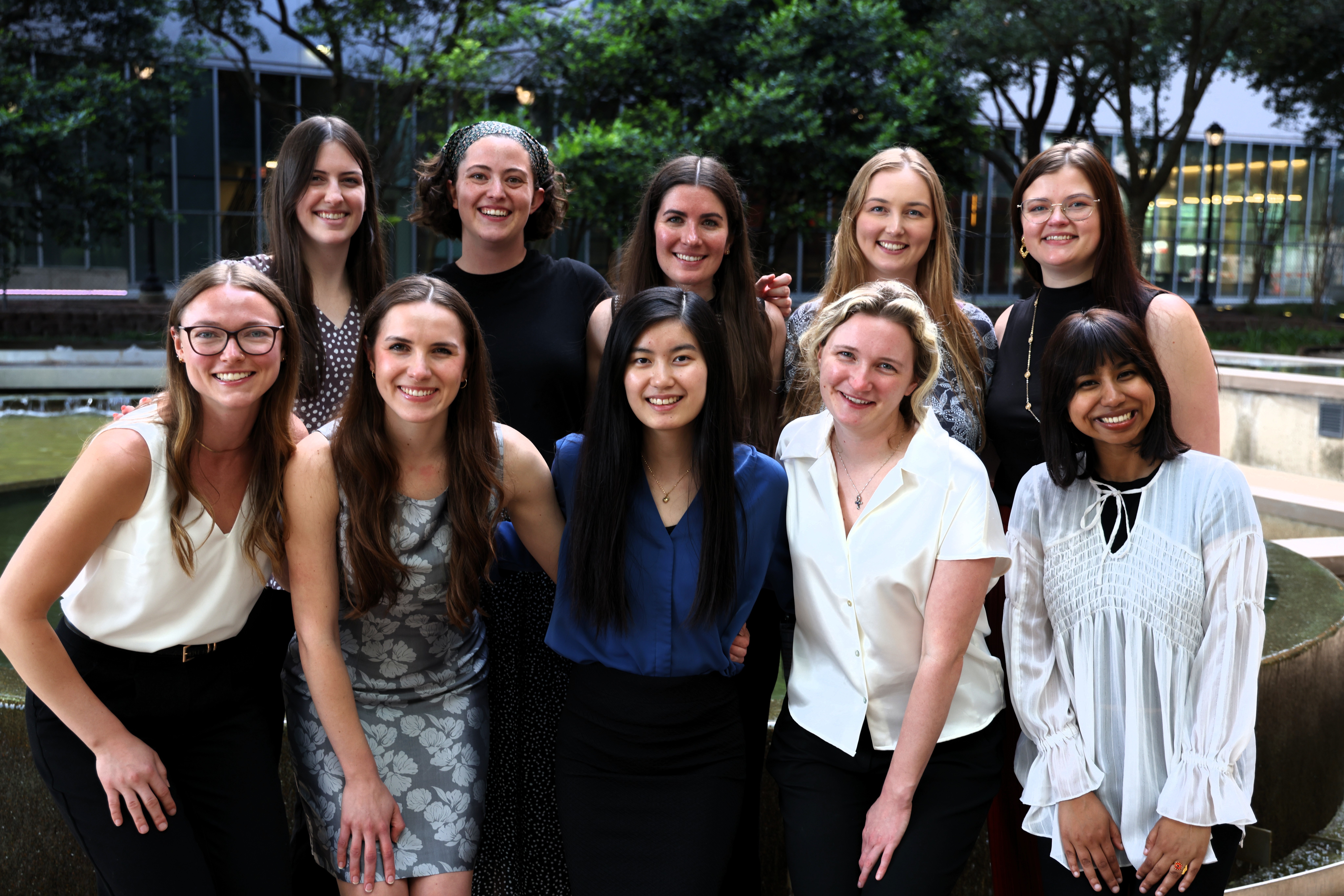
Scarlett with her UTHealth Houston’s Genetic Counseling Program (UTGCP) cohort celebrating Class of 2025's graduation.
Her journey has been supported at every step by family and friends, including her parents and sister, a recent Penn State meteorology graduate. And through the long nights of studying, one companion has been constant: her cat, Frankie — short for Rosalind Franklin.
As Scarlett prepares to graduate, she leaves behind a record of achievement and a clear sense of purpose: to advance genetic counseling, expand access to care, and guide patients through some of their most important decisions.
Founded in 1989, The University of Texas Genetic Counseling Program (UTGCP) offers a challenging and unique program in genetic counseling administered through the University of Texas MD Anderson Cancer Center UTHealth Houston Graduate School of Biomedical Sciences in association with the Division of Medical Genetics in the Department of Pediatrics at the McGovern Medical School.