


Collin Harlan’s path to NIH funding for cancer immunotherapy research
January 16, 2026
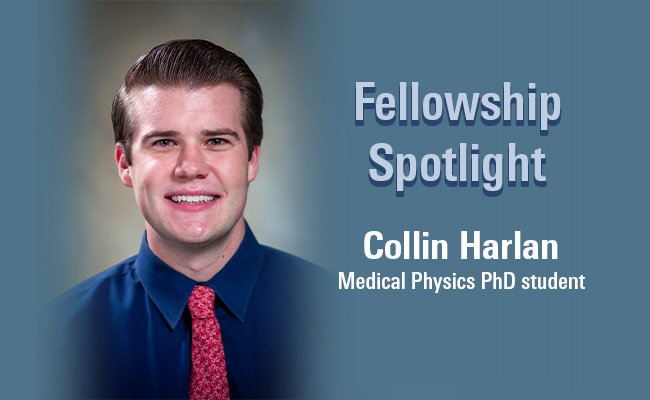
For fifth year Medical Physics PhD student Collin Harlan, writing a 101-page National Institutes of Health (NIH) National Cancer Institute (NCI) F31 grant application wasn’t just a hurdle — it was a defining moment in his scientific training. The process sharpened his scientific writing and project coordination skills while securing funding for his research on tracking immunotherapy delivery in pediatric cancer.
Harlan’s specific fellowship is the PA-25-422 (Parent F31): 129Xe Hyperpolarized Chemical Exchange Saturation Transfer (HyperCEST) MRI for Tracking Immunotherapy Delivery in the Lungs. The F31 is an NIH fellowship aimed at supporting PhD candidates conducting dissertation research in biomedical sciences.
Personal connection to cancer inspires research
Harlan’s motivation for his research began when his mother was diagnosed with glioblastoma in 2013, an aggressive form of brain cancer. At the age of just 17, Harlan witnessed his mother undergo difficult cancer treatment from brain surgery to radiation and chemotherapy. Though doctors initially only gave Harlan’s mother 12 months to live, his mother’s tumor miraculously remained stable for seven years. Rather than losing his mother as a high school student, Harlan’s mother was able to witness his college graduation from Texas A&M, meet his fiancée, and celebrated his first publication and acceptance into the Medical Physics PhD program at the Graduate School. Unfortunately, Harlan’s mother passed away during his first year of graduate school. He carries the resilience of caring for his mother and her memory through all of his research, deeply understanding how success in his own work positively impacts the lives of other families navigating cancer diagnoses.
Harlan has had many successes during his research journey at the Graduate School. After being appointed to the MD Anderson/Rice Cancer Nanotech T32 grant for three years, Harlan applied for the prestigious F31 fellowship as it aligned with the T32’s requirements and his own research trajectory. Harlan’s fellowship investigates how to noninvasively and accurately track the delivery of natural killer cell-based immunotherapy to the lungs in osteosarcoma patients using magnetic resonance imaging (MRI). Current immunotherapy approaches have no means to verify that these immune cells localize appropriately, which can contribute to high treatment failure rates for pediatric metastatic osteosarcoma. Harlan utilizes nanodroplet labeling of natural killer cells combined with Xenon gas MRI to image immunotherapy delivery.
Writing accountability support: keys to success for fellowships
The F31 requires 19 separate and unique documents for completion. Harlan’s application totaled 101 pages. He wants applicants to know that setting up a support system through both your peers, mentor and the graduate school are the best recipe for success. Collin specifically encourages his peers to take the NIH Fellowship Proposal Development course offered each Fall and Spring through the graduate school.
“The combination of peer encouragement, structured guidance from GSBS, and mentor investment made the daunting process feel collaborative and achievable. I credit much of my success to the fellowship development course — it gave me the framework, examples, and pacing I needed to complete the application on time.”
The sheer volume of writing for NIH fellowships can be overwhelming and Harlan found himself losing valuable writing time worrying about what to write rather than writing — a common roadblock for any grant writer! To tackle this, he blocked off manageable chunks of time for writing in his weekly schedule. He recommends two essential questions to hold yourself accountable each writing session:
- What will I get done TODAY?
- What steps will I get done TODAY to achieve this goal?”
Learning to love writing — and where it can lead
Harlan discovered a love of grant writing through this process. He highlights his organization skills and ability to coordinate scientific products as key factors in keeping his fellowship on track. His newfound success in scientific writing reinforced his career aspirations to become a clinical MRI physicist in academic research. He plans to obtain a position as a professor to combine his love for research, teaching, and clinical experience to shape the future of Medical Physics for the next generation.
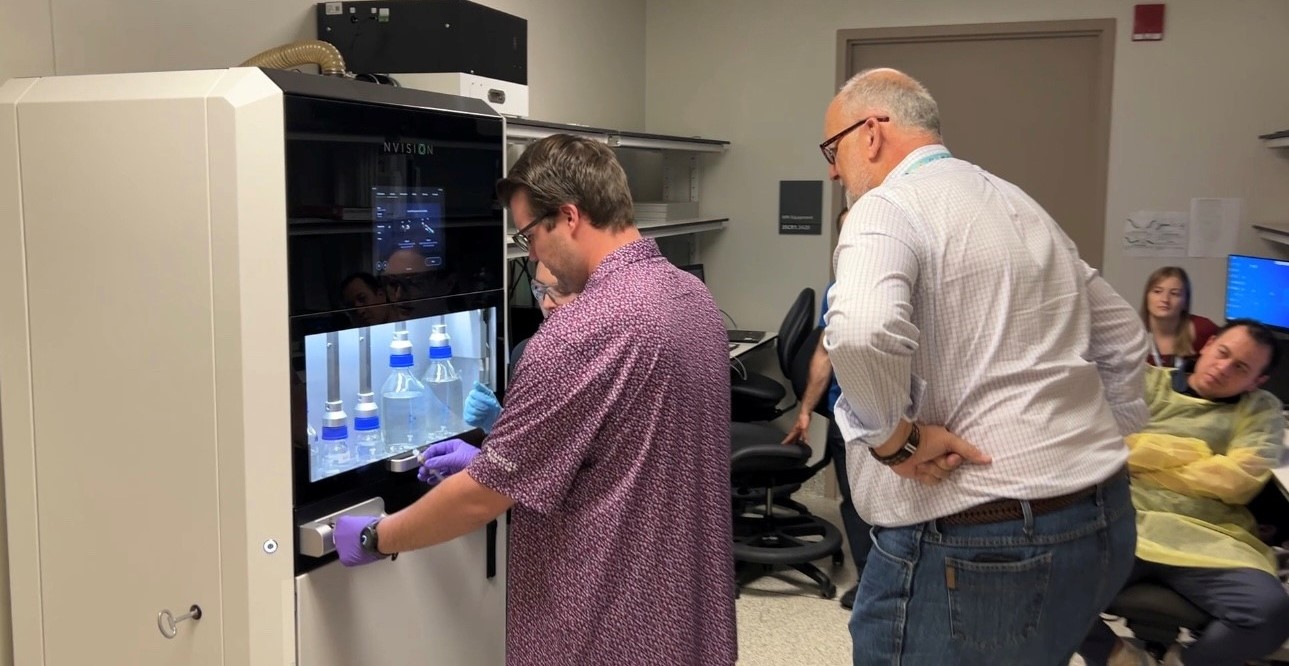
Harlan (left) demoing a new hyperpolarizer as part of his research.