




January's Paper of the Month highlights the challenges of persistent Staphylococcus aureus in catheterized patients
January 21, 2026
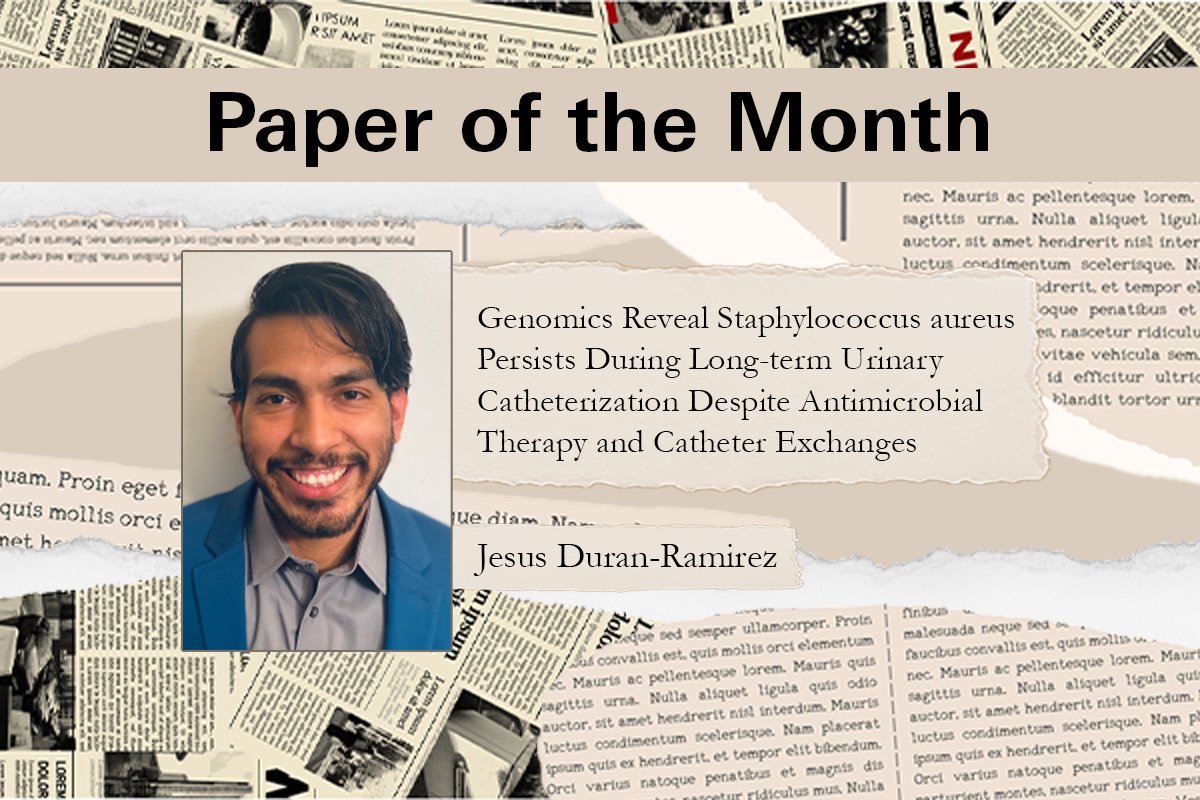

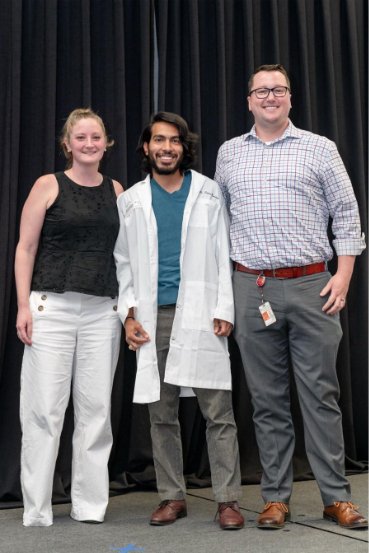
Paper of the Month: Genomics Reveal Staphylococcus aureus Persists During Long-term Urinary Catheterization Despite Antimicrobial Therapy and Catheter Exchanges
Intended to support and improve patient health, medical devices are used by millions each year. Despite being an indispensable part of health care, medical devices are often the cause of healthcare-associated infections, caused by a range of microbial pathogens that develop antibiotic resistance. Jesus Duran-Ramirez, a PhD candidate in Microbiology and Infectious Diseases program, who is co-mentored by Jennifer Walker, PhD, and Blake Hanson, PhD, studies the various virulence mechanisms that underlie severe disease in catheter-associated urinary tract infections.
Genomic study of understudied uropathogen Staphylococcus aureus
Urinary catheters are the most frequently placed medical devices, used to manage hospitalized and critically ill patients. A significant challenge in maximizing their efficacy are the high rates of symptomatic catheter-associated urinary tract infections (CAUTIs) and asymptomatic bacteriuria (ASB), which remain high despite prophylactic and empiric antibiotic treatment and with limited prevention strategies. In fact, CAUTIs are the most common hospital-associated infections in the U.S. and diminish quality of life in patients as they can progress disease and cause severe complications.
While scientists have previously shown that a range of pathogens including Escherichia coli and Klebsiella pneumoniae, cause these infections, the majority of uropathogens remain understudied. To address this critical barrier in developing effective treatment strategies, Duran-Ramirez’s article in Nature Communications addresses S. aureus in long-term catheterized individuals with genomic study of clinical S. aureus isolates.
Whole-genome sequencing was used to study the uropathogen in 171 longitudinal samples from 20 long-term catheterized patients from urology outpatient clinics and nursing homes. Duran-Ramirez shares that because clinical isolates behave differently than laboratory reference strains, rigorous analyses and interpretation of the genomic data were required. Their analyses show that co-isolated S. aureus strains — isolates collected from a single patient at a single time that display phenotypic heterogeneity — share the multi-locus sequence type but differ in their accessory genomes, as seen in methicillin-resistant and methicillin-susceptible strains collected from a single patient at one time point. This finding indicates that some patients harbor the heterogeneous population of S. aureus, with genomic differences explaining antibiotic differences, while others have a single, homogeneous strain colonizing.
Phylogeny of S. aureus long-term urinary catheter isolates shows genomic changes
Longitudinal sampling allows for the study of genomic changes in population over time, as individuals exchange catheter, receive antibiotics, or develop resistance. Duran-Ramirez and team sought to understand longitudinal strain changes using phylogenic analyses, which revealed that 90% of individuals were colonized by strains of the same lineage over time and minor instances of sequence type changes. Notably, isolates with sequence type changes showed large shifts in the accessory genome (median 126 differences) in contrast to isolates that maintained the same lineage (median 3). Accessory genome changes in genes associated with mecA casette, genetic element that confers antibiotic resistance, were also observed in methicillin-resistant strain compared to the longitudinal methicillin-susceptible strains.
Using genomic profiles to predict antimicrobial susceptibility in S. aureus
Whole-genome profiles of all isolates revealed determinants of antibiotic resistance, including missense mutations, that explained the observed phenotypes. To evaluate antimicrobial susceptibility to the most prescribed antibiotics for urinary tract infection, Duran-Ramirez performed minimum inhibitory concentration (MIC) assays. Specifically, index (initial) and final longitudinal strains, along with selected intermediate isolates showing changes in antimicrobial resistance (AMR) gene content, were tested. Notably, phenotypic resistance to oxacillin was concordant with mecA carriage in genomic profiles, including in cases where a missense mutation in the mecA could explain the restored susceptibility. With a strong concordance between genotypic and phenotypic antimicrobial susceptibility patterns, they demonstrate how genomic analyses can be used to effectively contextualize and study antimicrobial resistance and pathogen evolution.
Driving discovery in S. aureus urinary tract infections
These findings challenge the prevailing assumption that catheter exchanges and antibiotic treatment are sufficient to eliminate the persistent strains of S. aureus. They also provide a foundation for understanding how these strains adapt to persist and cause infection in the long-term catheterized individuals. Building on this work, Duran-Ramirez is now investigating how the isolates evolve genomically as they remain in the urinary tract.
Duran-Ramirez developed interest in studying host-pathogen evolution and infectious diseases from his early exposure to translational biomedical research and a desire to work with clinically relevant samples. He shared that
“Preparing this manuscript reinforced my interest in longitudinal studies and pathogen evolution, and it solidified my goal of pursuing independent research focused on infection persistence and prevention.”
Passionate about translational infectious disease research, Duran-Ramirez aims to study clinically relevant isolates to deepen our understanding of pathogen evolution and advance infection prevention and antibiotic stewardship as an independent investigator.
Paper of the Month (POM) is a collaborative effort led by Microbiology and Infectious Diseases PhD candidate Jana Gomez, Communications Manager Shelli Manning, and Communications Assistant Lauren Nguyen, and overseen by Associate Dean for Academic Affairs Francesca Cole, PhD, who work with students to summarize fellow student-authored scientific articles about their biomedical science research and the innovative methods and discoveries they are uncovering. The POM editorial team includes students Shraddha Subramanian, Mirrah Bashir, Amanda Warner, Chae Yun Cho (author of January's POM summary), Altai Enkhbayar, Zarmeen Khan, Archit Gupta, and Sheighlah McManus.